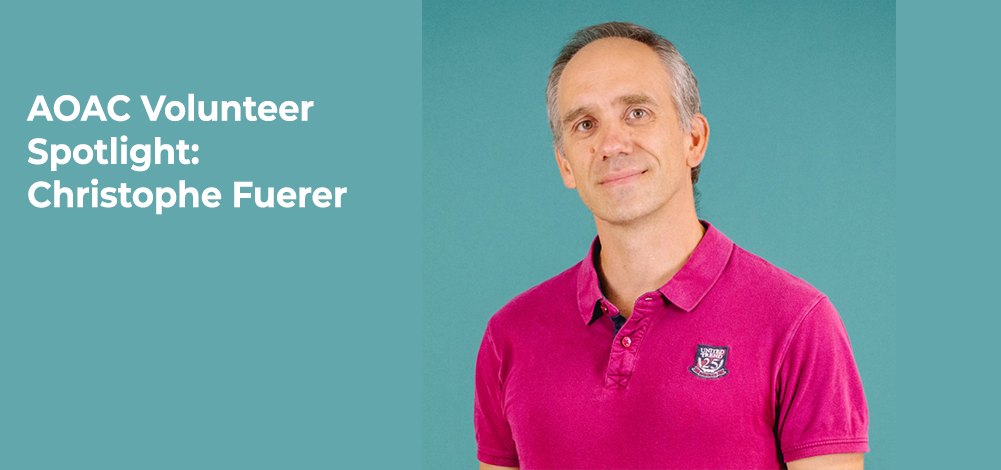
Volunteer Spotlight with Christophe Fuerer:
The Value of Engaging with Experts to Improve Food Quality and Safety
Inside Laboratory Management’s volunteer spotlight series offers a glimpse of just a few of AOAC’s many exceptional and dedicated members who give their time and expertise to the Association. From authors and special guest editors to working groups, expert review panels, and much more, AOAC is able to provide a suite of analytical solutions that give confidence in results due to the commitment of its volunteers.
In the May/June 2025 issue, we celebrate Christophe Fuerer, who joined as a member nine years ago and is actively involved in many roles and projects at AOAC. He shares the value of engaging with experts to improve food quality and safety through standardized methods, how participating can benefit one on a professional and personal level, and advice to members looking to get involved.
_____________________________________________________________________________________
From established AOAC science programs like infant formula to newer priorities like novel foods, Christophe Fuerer, Société des Produits Nestlé SA, Switzerland, is actively playing a role in helping shape the direction of AOAC initiatives. Since joining in 2016, he has served the Association in many capacities, including as an advisory panel member, working group member, working group co-chair, and expert review panel (ERP) member–all with the common goal of standardizing analytical methods to improve food quality and safety.
“AOAC is a valuable organization for improving food quality and safety through better and more accurate identification, characterization, and quantitation of proteins in food,” says Fuerer, whose research focuses on protein analysis. “Standardizing analytical methods is key to achieving this goal by ensuring robust and consistent results across laboratories.”
Fuerer, who has an MSc in Biochemistry and PhD in Biology and Virotherapy, is a senior R&D specialist at Société des Produits Nestlé SA. (“None of the viruses I created during my PhD generated an outbreak,” he says.) He has 20 years of experience implementing mass spectrometry, molecular and cellular biology, and biochemistry approaches to develop innovative solutions to assess the role and function of proteins. At Nestlé, Fuerer provides analytical solutions for protein-related issues that meet the needs of R&D and operations, ensuring appropriate and robust analytical methods for proteins, peptides, amino acids, and nitrogen.
“To feed the growing population that is projected, there is significant focus on novel foods from alternative protein sources,” said Kate Mastovska, AOAC deputy executive director and chief science officer. “This rapidly growing sector has brought new challenges in terms of new matrices and/or analytes that need to be tested to assess the quality and safety of these novel foods. In addition, it also challenges traditional analytical approaches, such as the analysis of protein content. Christophe’s insight and expertise in this area have been pivotal in developing standards for amino acid analysis for new food matrices.”
Fuerer first became involved with AOAC as a method author for the quantification of whey protein content in milk-based infant formula powders (AOAC Official MethodSM 2016.15) and total amino acids in infant formula and adult nutritionals (AOAC Official MethodSM 2018.06). His work on infant formula was a natural segue to participating on working groups for the AOAC Stakeholder Program on Infant Formula and Adult Nutritionals (SPIFAN) to develop standards for beta-casein A1/A2, lactoferrin, and milk fat globule membrane proteins. He then joined the AOAC ERP on SPIFAN Nutrient Methods to evaluate candidate methods for consideration as AOAC First and Final Action Official MethodsSM. Fuerer goes above and beyond reviewing methods for the ERP, sometimes running parts of the methods himself to ensure scientific soundness and fitness-for-purpose, contributing to the robustness of AOAC Official MethodsSM.
Fuerer was also a member of a working group for the AOAC Stakeholder Panel on Strategic Food Analytical Methods (SPSFAM) to develop AOAC Standard Method Performance Requirements (SMPRs®) for detection of food allergens.
More recently, he has been involved in AOAC initiatives on novel foods and dairy protein hydrolysates. For novel foods, Fuerer serves as co-chair of the working group to develop SMPRs for total amino acids in new food matrices. In addition, his team at Nestlé participated in numerous multilaboratory testing studies to help demonstrate accuracy of methods.
“Christophe actively supports numerous AOAC initiatives through his significant involvement in SPIFAN, novel foods, and dairy protein hydrolysates programs,” says Greer Harris, manager of Science Programs at AOAC. “He also attended the AOAC webinar on organic authenticity, demonstrating his continuous commitment to learning and engagement. His dedication to science goes beyond solely AOAC activities as he is also instrumental in advancing collaboration between ISO/IDF and AOAC. We are fortunate to have volunteers like Christophe who are committed to improving global analytical standards and methods.”
For Fuerer, “Volunteering with AOAC allows me to further my passion to standardize robust analytical methods, which are key to ensuring food quality and safety and a core aspect of my job,” he says.
As a member of AOAC, Fuerer values “being part of a community of scientists who work together to achieve excellence in analytics and reach consensus through honest exchanges and open discussions.” Delivering scientifically sound, fit-for-purpose methods and having mutual respect of other scientists are aspects he enjoys most about volunteering.
“Through my activities at AOAC, I have built a valuable network of experts and shaped new analytical standards that are crucial for ensuring food quality and safety, demonstrating regulatory compliance and facilitating international trade,” says Fuerer.
To members considering volunteering, he stresses the importance of being involved.
“Participating in standardization activities benefits all stakeholders and, ultimately, consumers,” he says. “Take an active part in discussions to help ensure that the needs of your organization are heard. On a personal level, being involved allows you to connect with a diverse range of scientists from other companies and geographies, broadening your horizons.”
Fuerer advises that it is important to “ensure you have full support from your company.”
“Volunteering is a time commitment, but it’s worth it,” he says. “It’s a great opportunity to expand your network and knowledge and keep your organization abreast of the latest information.”
AOAC thanks Fuerer for his time and dedication. Inspired to get involved? Visit the AOAC website for more information on volunteer opportunities.