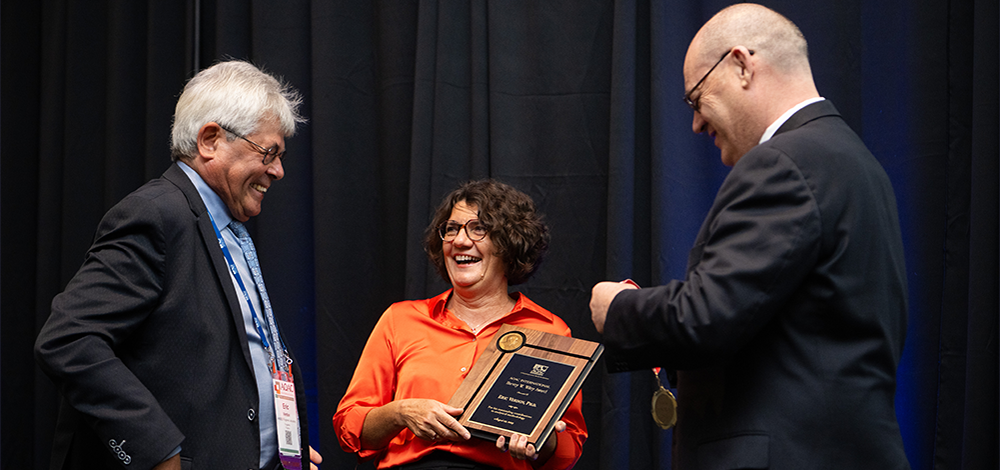
AOAC INTERNATIONAL 2024 – 2025 Board President Danièle Sohier (center) and Brendon Gill, Official Methods Board Chair (right), present Eric Verdon (left) with the Harvey W. Wiley Award.
Rockville, Maryland, September 26, 2025—AOAC INTERNATIONAL honored analytical science leaders in an awards ceremony at the AOAC INTERNATIONAL 2025 Annual Meeting & Exposition in San Diego, California, on Monday, August 25. Awards recognized scientific excellence across the spectrum of AOAC collaboration, including method development, expert review panels, editorial contributions to the Journal of AOAC INTERNATIONAL, and technical service.
The Harvey W. Wiley Award, presented each year for outstanding contribution to analytical method development in an area of interest to AOAC INTERNATIONAL, went to French chemist Eric Verdon. Verdon is the head of the European Union Reference Laboratory (EU-RL) for Antibiotic Veterinary and Dye Residues in Food from Animal Origin. He also heads up the French national reference laboratory at ANSES, the French Agency for Food, Environmental, and Occupational Health Safety. Verdon’s engagement in analytical chemistry has notably influenced the field of Veterinary Drug Residue Control in Foods.
The Fellow of AOAC INTERNATIONAL Award, which recognizes the dedication of volunteers who serve the Association, was awarded to two outstanding members: Salvatore Parisi, Lourdes Matha Institute of Hotel Management and Catering Technology, Kerala State, India; and Jeffrey Shippar, Eurofins Food Testing, Madison, Wisconsin.
AOAC also recognized current students’ research endeavors at the awards ceremony. Some student award winners receive travel and registration to the Annual Meeting and the opportunity to present their research there, as well as a cash award.
The Harvey W. Wiley Scholarship Award was awarded to Gaël Touchais, French Agency for Food, Environmental and Occupational Health & Safety (ANSES), University of Rennes, Doctoral School: Life and Health Sciences (ED SVS). He is a current PhD student studying analytical chemistry. This scholarship recognizes a student who has made an outstanding contribution to analytical method development.
The AOAC/Eurofins Foundation “Testing for Life” Student Award was presented to five student innovators who submitted abstracts on basic or applied research in support of analytical or molecular testing for food safety, food security, food defense, food authenticity, or health and environmental protection. The winners were Julia Andronache, University of Vienna, Austrian Agency for Health and Food Safety (AGES), Austria; Yihang Feng, University of Connecticut, Mansfield, Connecticut, USA; Chamali Kodikara, University of Manitoba, Winnipeg, Manitoba, Canada; Eva Czmorik Ludvickova, University of Chemistry and Technology (UCT), Prague, Czech Republic; and Gururaj Moorthy, Prince of Songkhla University, Songkhla, Thailand. In addition to a cash award, the five young scientists will submit an article for AOAC’s Inside Laboratory Management magazine.
The AOAC INTERNATIONAL/Herbalife Scholarship, supported by contributions from Herbalife and designed to encourage student researchers who are advancing analytical or molecular (DNA) testing in herbal or dietary supplements, was awarded to Sheng-Luen (Kevin) Shih, University of Wisconsin-Madison, Madison, Wisconsin, USA; and Matej Maly, University of Chemistry and Technology (UCT), Prague, Czech Republic.
AOAC’s Official MethodsSM Board presented the Method of the Year to AOAC Official MethodSM 2021.01 “β-Galactooligosaccharides (GOS) in Infant Formula by UHPLC” and its method authors Sean Austin and Denis Cuany, Société des Produits Nestlé, Lausanne, Switzerland. AOAC 2021.01 offers an innovative approach to addressing challenges in analyzing GOS in products with a high background of lactose or galactose, specifically in infant formula and dairy products.
The Technical Service of the Year Award went to Thomas Gude, Thomas Gude GmbH, Aarau Rohr, Switzerland. Gude has served as president of the AOAC Europe Section for the 2022-2025 term, leading key initiatives focused on nontargeted testing and the application of bioassays in food analysis. His exemplary volunteer service lays the groundwork for how analytical challenges faced by AOAC sections can transition into AOAC science programs.
The award for Achievement in Technical and Scientific Excellence went to the AOAC Gluten and Food Allergens (GFA) Program Working Group on Food Allergens, one of the largest and most engaged in developing AOAC standards. In 2023, the group completed the standard guidelines, “Guidance on Food Allergen Immunoassay Validation,” which encompass both qualitative and quantitative method validation. Presented by the AOAC Official Methods Board, the award recognized outstanding volunteer commitment and leadership.
The Expert Review Panel for Enzymatic Methods won the Expert Review Panel of the Year award for demonstrating an extraordinary level of productivity, reviewing and adopting nine methods over 11 meetings—an unprecedented achievement within a single calendar year. The panel was chaired by Sneh Bhandari, SDB Associates, and Darryl Sullivan, Eurofins Scientific, and included members Philip Haselberger, Abbott Nutrition; Abdelharam Ismail, Tate & Lyle; Ruth Ivory, Neogen; George Joseph, AsureQuality; Sima Patel, Tate & Lyle; John Szpylka, Certified Group, retired; Tom Vennard, Mead Johnson Nutrition; and Sudhakar Yadlapalli, First Source Laboratory Solutions.
The Best Manuscript Award,recognizing the most outstanding and creative article in the peer-reviewed Journal of AOAC INTERNATIONAL, went to “Using Liquid Chromatography—Isotope Ratio Mass Spectrometry for Detection of Economically Motivated Adulteration of Maple Syrup”by Madhavi Mantha, Kevin M. Kubachka, John R. Urban, Jana L. Brueggemeyer, Lisa A. Kaine, and Reagan A. Patton, U.S. Food and Drug Administration, Office of the Chief Scientist, Detroit Medical Products Laboratory, Detroit, Michigan, USA.
The Section of the Year Award was presented to the AOAC Europe Section. The Section’s participation in AOAC standards development activities, such as those for PFAS, underscores the section’s proactive role in addressing critical regional issues. Sections provide opportunities for participants to share information, build professional contacts, expand leadership skills, and gain practical management experience. There are 15 AOAC Sections that connect analytical communities in the U.S. and worldwide, representing four continents and more than 120 countries.
Five poster authors won the First-Time Poster Contest: Kevin Posman, Bigelow Analytical Services; Tadas Kargelis, Neogen; Alexander Schrum, Shodex (Resonac America Inc.); Armando Colorado, Midwest Laboratories; and Teresa Perez, Biosystems, S.A.
In addition, 182 AOAC INTERNATIONAL members were recognized for their years of service, including one individual who has contributed their expertise to the organization for an impressive 50 years, five 45-year members, two 40-year members, one 35-year member, four 30-year members, 11 25-year members, 48 10-year members, and 110 five-year members.
To view the full list of leaders profiled in these awards, visit the 139th AOAC Annual Meeting and Exposition Awards page.
###
About AOAC INTERNATIONAL
Founded in 1884 with beginnings in the USDA and US FDA, AOAC INTERNATIONAL is an independent, non-profit membership association of analytical science professionals across government, industry, and academia worldwide. Its mission is to advance food safety and product integrity through standards, validated test methods, and laboratory quality programs. AOAC publishes outcomes in the Journal of AOAC INTERNATIONAL, and its methods and standards in the Official Methods of AnalysisSM. It also provides laboratory proficiency testing programs and facilitates collaboration and training of scientists and other stakeholders to address challenges with sustainable analytical solutions. For more information, please visit AOAC.org.
Contact: Margaret Bell, Communications Manager
Phone: (240) 801-8646
Email: [email protected]